Lots, fence lines and overgrown acreage · Toledo, OH and Monroe County, MI
Brush and land clearing in Toledo, Ohio
Most land clearing in the Toledo area is a mix: honeysuckle and buckthorn understory, saplings, a fence line of volunteer trees, and somewhere in the middle two or three big trees that are the real job. A brush crew stops at those; a crew with its own crane and loaders does not. This page covers what clearing a lot, a fence line or a building site involves on either side of the state line, what must be checked before the first cut, and what to send for an estimate. The work is performed by a partner crew licensed in both Ohio and Michigan.
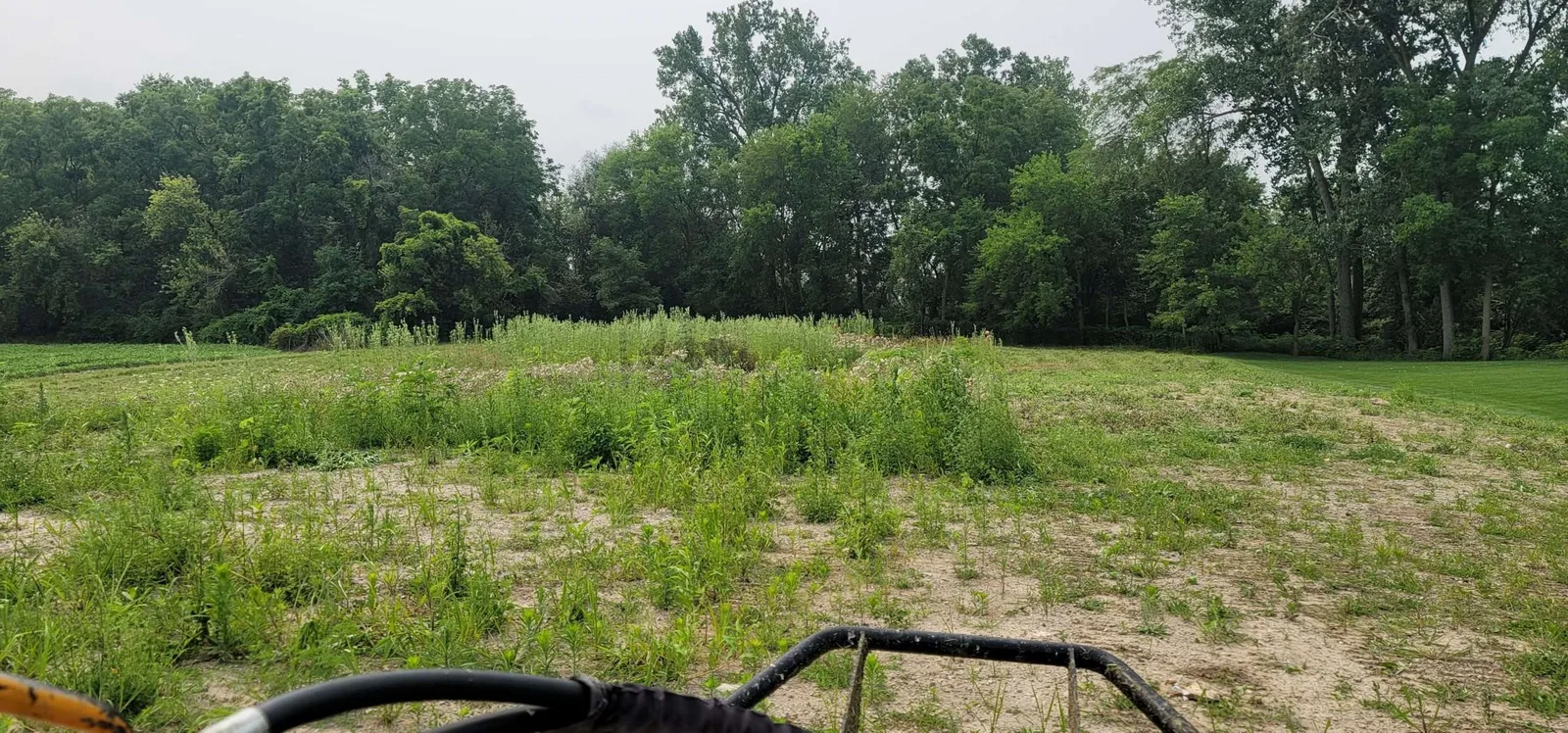
What does land clearing cover?
Everything between the property line and bare ground: understory brush, saplings, vines, fence-line trees, downed wood, and the mature trees that stand in the way of what the parcel is for. Typical jobs in Lucas, Wood, Fulton and Monroe counties: a building site for a house or barn, a fence line that has grown into a hedgerow of volunteer mulberry and boxelder, an overgrown lot behind a business, a wooded back acre a new owner wants to see the end of, and a farm field edge that has crept ten feet inward. Selective clearing — keeping the oaks, taking everything under them — is the more common request than clear-cutting. Small brush-only jobs are the same process at a smaller scale; a single large tree on an otherwise clear lot is a tree removal.
What about the big trees in the middle of it?
They are the part of the job that decides who can do it. A skid steer with a mulching head clears an acre of brush in a day and stops at a 24-inch trunk. On most parcels the big trees are exactly where a house or a drive is planned, or they lean over the neighbor’s garage, or they are dead ash — the emerald ash borer has been in Northwest Ohio since 2003 and an infested ash dies within three to six years, so any wooded lot here has standing dead ash in it. Those come down the same way they do in a yard: bucket where it reaches, crane where it does not, and the sections loaded out rather than pushed into a pile. Because the crew on this site owns its cranes and runs its own loaders, the big trees are part of the scope instead of a separate contractor and a second mobilization. The size guide is the reference for which trees need which method.
Forestry mulching, grapple and haul, or a mix?
Mulching grinds brush and small trees in place and leaves the chips; grapple-and-haul removes the material and leaves bare ground; most lots get both. Mulching is fastest and cheapest for understory and saplings, needs no hauling, and leaves a layer of chips that suppresses regrowth and protects the soil — but the chips stay, the stumps of anything larger stay at grade, and it is not what you want where a foundation or a driveway is going. Grapple-and-haul is for the wood too big to mulch, for debris piles, and for sites that must be clean. Large trunks are bucked and loaded on a log truck; brush that is not mulched is chipped. Stumps are a separate decision — ground where the site will be lawn or paved, left where it will stay wooded; see stump removal. Grading and topsoil are not tree work; say if you need them so the estimate says who does what.
| Method | Best for | What stays | Limits |
|---|---|---|---|
| Forestry mulching | Understory brush, saplings, vines, fence lines | A layer of chips; stumps at grade | Stops at roughly 24-inch trunks; not for building footprints |
| Grapple and haul | Debris piles, downed wood, sites that must be clean | Bare ground | Hauling is the cost; needs truck access |
| Bucket or climb removal | Mature sound trees among the brush | Stump unless ground | Bucket needs firm access within reach |
| Crane removal | Big, dead or leaning trees over a structure or line | Stump unless ground | Needs one setup position; permit if on the road |
What has to be checked before clearing a lot?
Property lines, utilities, water, and the tree rules of whichever municipality the parcel is in. Clearing to the wrong line is the most expensive mistake on a fence-line job; find the pins or have the line staked. Any grinding or grubbing is excavation, so an OHIO811 locate on the Ohio side or a MISS DIG 811 locate in Michigan comes first. Wetlands and stream corridors are regulated on both sides of the line; if the parcel has standing water, a ditch or a creek, confirm what is permitted before anything is cut. Trees in a road right-of-way are not yours: along a Toledo street they are public trees under Municipal Code Chapter 917, and along a Monroe County road any work in the right-of-way needs a Road Commission permit (734-240-5132). Sylvania, Maumee, Perrysburg and Ottawa Hills have tree chapters of their own; the service-area index links each municipality’s page. Lines overhead are the utility’s: Toledo Edison on the Ohio side, DTE in Monroe County, and neither clears a lot for you.
Clearing on the Michigan side
Bedford Township, Temperance, Lambertville, Erie and the townships around Monroe have the larger lots and the wooded back acres, and most Toledo crews do not cross the line to clear them. The partner crew is licensed in both Ohio and Michigan and brings the same mulcher, loaders and cranes to Monroe County that it runs in Lucas County. What changes across the line: MISS DIG 811 instead of OHIO811, the Monroe County Road Commission instead of the Toledo Division of Transportation for right-of-way, DTE instead of Toledo Edison, and the oak-wilt rule — no cutting or wounding live oaks between April 15 and July 15 in Southeast Michigan, which sets the season for any selective clearing that keeps the oaks. The Ohio vs Michigan guide covers all of it.
What to send for a clearing estimate
The address or parcel, the approximate area, what the cleared ground is for, what must stay, and a few wide photos. Say whether you want the material mulched in place or hauled, whether stumps are to be ground, and whether there are big trees in the scope — count them and guess the trunk diameter (circumference ÷ 3.14). Note water, slope, soft ground and the width of the access from the road. A walk-through with the crew sets the scope and the number; an aerial view from the county GIS site helps with acreage. Request a clearing estimate.
Questions
Frequently asked questions
What size clearing projects do you handle?
From a fence line or a single overgrown lot to several wooded acres. Describe the parcel and what it is for; the crew confirms the scope on a walk-through.
Is debris hauled away?
Mulched material stays as a chip layer. Anything grappled — wood too big to mulch, debris piles — is hauled unless you want the logs. Put hauling on the estimate so the scope is clear.
Can you take the big trees too?
Yes — that is the point of using a crew with its own crane and loaders. Mature trees, dead ash and anything over a structure come down as part of the same scope rather than a second contractor.
Do I need a permit to clear my lot?
Private clearing on your own land generally needs no tree permit in the Toledo area, but the road right-of-way, wetlands and stream corridors, and any municipal tree chapter can apply. Confirm the parcel’s rules before the first cut; the location pages carry each municipality’s chapter.
Do you clear land in Michigan?
Yes — Bedford Township, Temperance, Lambertville, Erie and the Monroe area, with a MISS DIG 811 locate and, if the work touches a county road right-of-way, a Monroe County Road Commission permit.
Not ready to talk yet?
Planning guides for brush and land clearing
The guide behind this page: Tree removal in Ohio vs Michigan.
Related services
- Tree removal — Planned removal of big trunks, dead ash and trees over structures — climbed, bucketed or lifted out by crane, on either side of the state line.
- Stump removal — Large-diameter grinding after a removal — depth, the 811 locate, roots and grindings, and the TMC 917.05 rule near street trees, on both sides of the line.
- Crane tree removal — Sections lifted straight up and out for dead ash, trees over a roof, and trunks too big or too boxed-in to rig — by a crew that owns its cranes.
Where this work is done
Metamora · Perrysburg · Bedford Township, MI · Lambertville, MI · all Ohio and Michigan municipalities
Request a brush and land clearing estimate
Roque Tree Service · BBB A+ · In business since 2010 · 33 Facebook reviews, 100% recommend
Partner crew licensed in both Ohio and Michigan. Owns the cranes it uses.