The big-tree method · Toledo, OH and Monroe County, MI
Crane tree removal in Toledo, Ohio
Crane tree removal lifts a tree out in sections instead of lowering them through the canopy — the method for dead ash, trees over a roof or garage, and trunks too big or too boxed-in to rig. On this site, crane removals in Toledo and across the Michigan line are performed by a partner crew that owns its cranes and plans the pick from the ground; send a wide photo and the address to start an estimate.
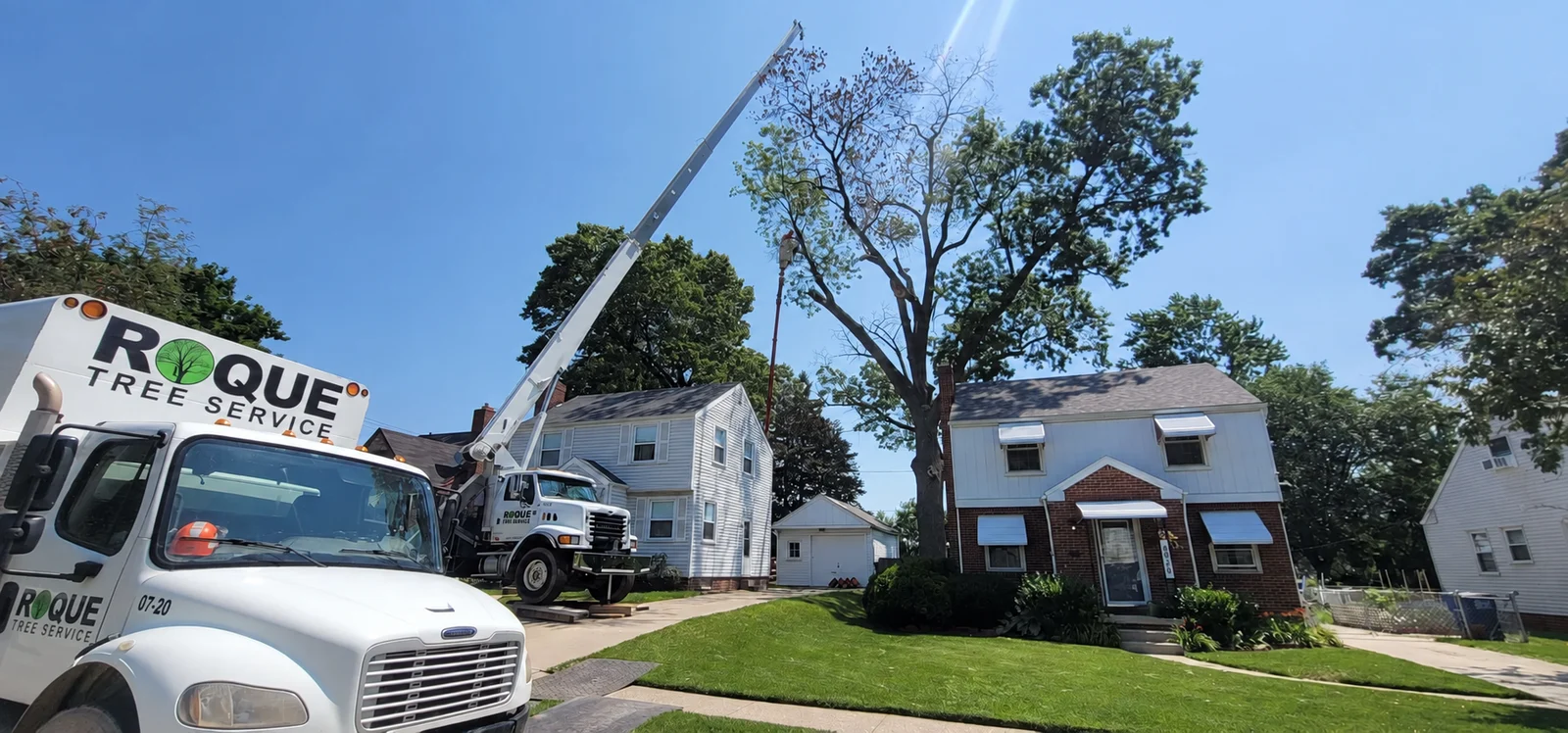
When is a crane the right method?
When one of four things is true: the tree is dead or brittle, there is a target underneath it, there is no room to rig, or the crown is beyond a bucket truck’s reach. Any one of them is enough. A borer-killed ash gives a climber nothing reliable to tie into. A silver maple leaning over a garage has no drop zone, so every section would have to be lowered by rope over the roof. A tree boxed in by a fence, a pool and a service drop has nowhere to swing pieces. And a crown 80 feet up is simply above where a bucket works from firm ground. The crane answers all four the same way: it holds each section before it is cut, then lifts it up and over whatever is in the way to a landing zone by the chipper.
Size alone does not decide it. A sound 30-inch oak in an open yard can be climbed and rigged by a full crew; a dead 20-inch ash over a sunroom cannot. The large-tree size guide gives the thresholds by trunk diameter and what sits underneath, and the crane pillar explains the mechanics in full. Table 1 is the short version.
| Climb and rig | Bucket truck | Crane | |
|---|---|---|---|
| Dead-tree suitability | No — no reliable tie-in | Yes, within reach | Yes — the standard answer |
| Reach | Anywhere a sound tree allows | Roughly 55–75 ft working height | Longest; set by the load chart at each radius |
| Access needed | A person and a chipper path | About 10–12 ft of firm ground | Truck access to one setup position; then reaches over obstacles |
| Lawn and driveway impact | Lowest | Truck footprint | Outrigger pads on mats; highest point loads |
| Typical use | Sound trees with a drop zone; tight backyards | Mid-size trees near the drive | Big, dead, leaning or boxed-in trees over structures |
What does a crane removal look like on the day?
Setup, a pick plan, a sequence of lifts from the top down, and a chipper and log truck working underneath the whole time. The crane arrives first and sets where the heaviest pick lands inside its load chart with margin — the driveway if it will take the load, the street if it will not. The partner crew, the BBB-accredited A+ partner crew that performs this work, sets outrigger pads on mats or plywood so the point loads spread instead of rutting a lawn or cracking a slab. Then the climber or bucket operator rides to the first cut, the rigger sets a sling on the section, the crane takes its weight, the cut is made, and the section floats up and over the house to the landing zone. Sections are sized to the chart: bigger picks near the crane, smaller ones at a long radius.
Underneath, brush goes straight into the chipper and trunk wood is bucked for the log truck, so the yard is clear as the tree comes down rather than at the end. Vehicles need to be out of the setup area before the crane arrives, gates unlocked, pets inside. How long it takes depends on the tree and the access — most residential crane removals in the area are a single day, but a very large tree, a long reach or a street closure that limits the working window can push it to two. The estimate should state the expected duration; treat any promise made before the site visit with suspicion.
Does the crane need to be in the street?
Often, for a front-yard tree or a tree near the tree lawn — and that means a right-of-way permit. In Toledo, when the crane, the chipper or the log truck occupies the street, sidewalk or tree lawn, the city’s Division of Transportation issues a right-of-way permit for the work; the crew, not the homeowner, applies for it and passes the fee through on the estimate. A flagger may be needed on a through street. In Monroe County, a crane on the shoulder of a county road — Lewis Avenue in Temperance, Sterns Road in Bedford Township — is work in the Monroe County Road Commission’s right-of-way and needs an MCRC permit (734-240-5132); a state trunkline such as US-23 or Telegraph Road is MDOT’s. A backyard tree reached over the roof from the driveway needs none of this, which is one reason the crew looks for a driveway setup first. The Ohio vs Michigan guide covers which permit applies where.
Dead ash and the other crane trees
In Northwest Ohio the crane tree is, more often than not, an ash. The emerald ash borer reached the region in 2003 and an infested ash dies within three to six years, so the ash canopy in Toledo, Sylvania, Ottawa Hills and across Monroe County is now mostly standing dead or already gone. A dead ash is brittle from the top down; limbs snap under a climber’s weight and the trunk can fail at a cut. It is removed from the ground, and when a bucket cannot reach the whole crown from firm ground, that means a crane. Silver maple is the second: the Ohio DNR describes it as a fast-growing tree to about 80 feet with weak, brittle wood, and Toledo’s post-war neighborhoods are full of them, leaning over garages with co-dominant leaders that split in wind. Cottonwood on wet ground and the big oaks of the older neighborhoods round out the list. The dead-ash guide covers each species and what it means for method and cost.
What affects a crane estimate?
Trunk diameter, access to a setup position, what is underneath, whether the tree is dead, and what you want done with the wood and the stump. The DBH band sets the weight of the picks and therefore the crane and crew size. Access decides whether the crane sits on the driveway (no permit) or the street (permit and possibly a flagger). A roof, pool or line under the crown means smaller, more careful picks. A dead tree means no climber and a plan built entirely from the ground. Hauling the wood, grinding the stump and the right-of-way permit are each separate lines. This page publishes no dollar figures: the partner crew has not supplied ranges for publication, and a crane number without the tree behind it is meaningless. The crane guide’s cost section shows how a worked example is priced, and the tree removal page carries the full cost-driver table.
One thing the estimate should not carry is a rental line. Most Toledo-area crews rent a crane and its operator by the day, which means waiting for availability, paying a markup, and having an operator on site who does not work with that crew every week. The crew on this site owns the cranes it uses, so the crane comes when the crew does and the operator is part of the team.
What to send for an estimate
The address, a wide photo, what is under the tree, the gate width, and whether the tree is in the yard or the tree lawn. Take the photo from across the street or the far side of the yard so the whole tree and the house are in frame; do not walk under a dead tree or near a line to get it. Say what is directly beneath the crown — roof, garage, fence, pool, deck, the neighbor’s house — and how wide the narrowest opening is between the street and the tree. If the tree stands between the sidewalk and the curb it is a public tree under Toledo Municipal Code Chapter 917 and the city removes it after its own inspection; report it through Engage Toledo at 419-936-2020 instead of requesting an estimate. Request a crane estimate.
Questions
Frequently asked questions
Will the crane damage the lawn?
The crane sets on four outriggers, each on a pad or mat that spreads the load. On a driveway the crew mats the slab; on a lawn it uses mats or plywood. Some marking on soft ground is normal, and the estimate should state what protection is used and what restoration, if any, is included.
Can the crane reach the backyard from the street?
Often, yes — that is the main reason a crane is chosen for a tree behind a house. The boom reaches over the roof and lifts sections out to the street without any machine crossing the yard. Reach depends on the load chart at that radius; a heavy pick far from the crane may need smaller sections.
Is a crane more expensive than climbing?
Sometimes, sometimes not. On a big or dead tree a crane replaces a full day of rigging with a few hours of picks, so it is often cheaper per hour of risk and sometimes cheaper outright. On a sound mid-size tree in an open yard, climbing is usually the better fit. The method follows the tree; there is no fixed premium.
Do you work in Michigan?
Yes. The partner crew is licensed in both Ohio and Michigan and takes crane jobs in Bedford Township, Temperance, Lambertville, Erie and the City of Monroe with the same cranes it uses in Toledo. The Ohio vs Michigan guide covers the permit and utility differences.
Is the crane operator part of the crew?
Yes. Because the crew owns its cranes, the operator works with the same climbers and riggers every week rather than being sent by a rental company for the day.
Does the crew pull the street permit?
Yes — the Toledo right-of-way permit or the Monroe County Road Commission permit, whichever applies, with the fee passed through on the estimate.
Not ready to talk yet?
Planning guides for crane tree removal
The guide behind this page: The complete guide to crane tree removal in Toledo.
Related services
- Tree removal — Planned removal of big trunks, dead ash and trees over structures — climbed, bucketed or lifted out by crane, on either side of the state line.
- Storm and urgent tree service — The order of operations when a tree is down: utility first, then a crane crew that works both sides of the line — with the insurance facts that decide who pays.
- Stump removal — Large-diameter grinding after a removal — depth, the 811 locate, roots and grindings, and the TMC 917.05 rule near street trees, on both sides of the line.
Where this work is done
Toledo · Ottawa Hills · Sylvania · Temperance, MI · all Ohio and Michigan municipalities
Request a crane tree removal estimate
Roque Tree Service · BBB A+ · In business since 2010 · 33 Facebook reviews, 100% recommend
Partner crew licensed in both Ohio and Michigan. Owns the cranes it uses.