Tree on the house, limb on the line · Toledo, OH and Monroe County, MI
Emergency tree service in Toledo, Ohio
If a tree or limb is touching a wire, call the utility before anyone else — Toledo Edison at 888-544-4877 on the Ohio side, DTE at 800-477-4747 or Consumers Energy at 800-477-5050 in Monroe County, depending on the property’s supplier. If someone is hurt or a structure is unsafe, call 911. Then request an estimate: a tree on a house is nearly always a crane job, because the trunk is loaded against the structure and cannot be cut in place. Storm and urgent work on this site is performed by a partner crew that owns its cranes and works both sides of the state line.
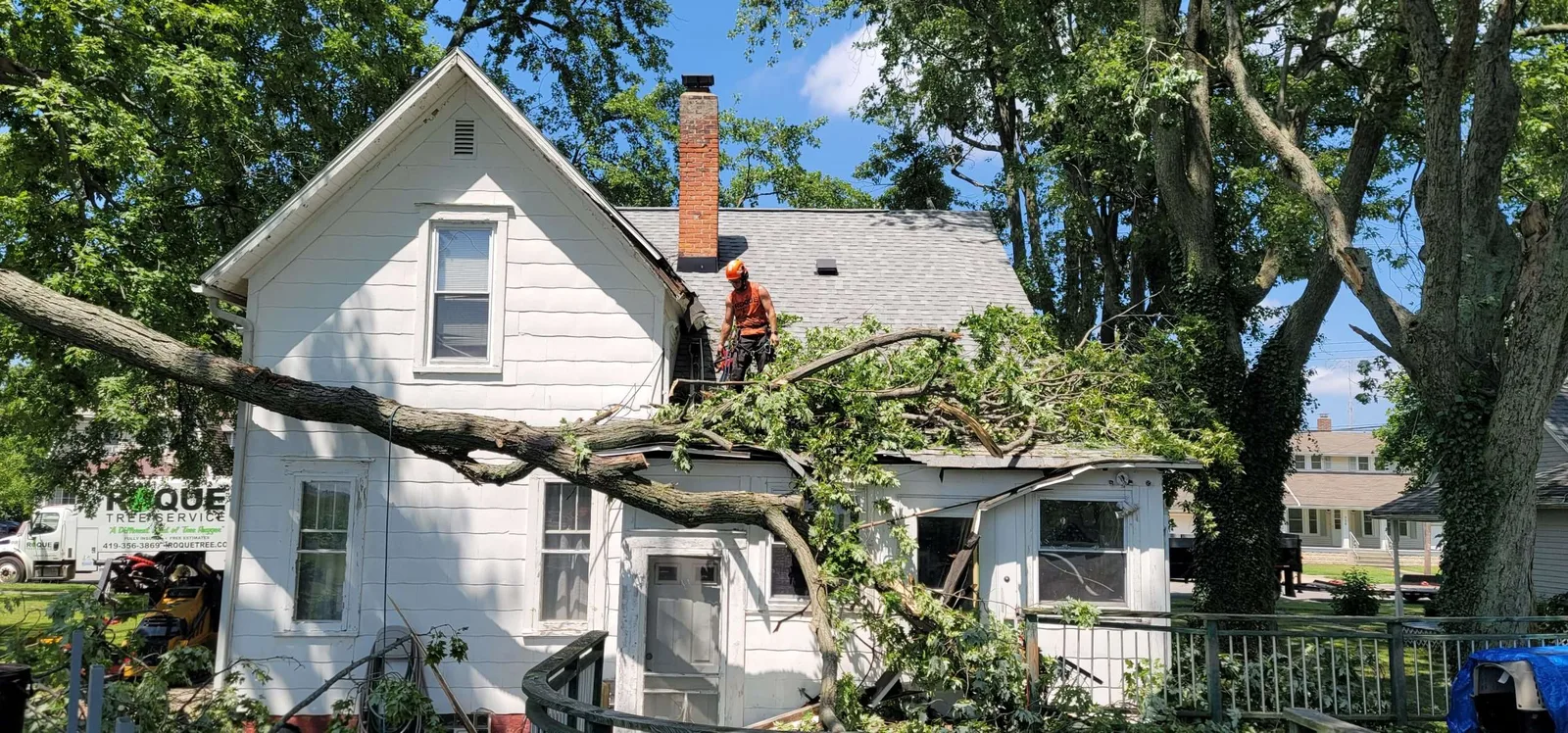
What do you do first when a tree is down?
Wires, people, structure, then the tree — in that order. Treat every downed or sagging wire as live. Toledo Edison, a FirstEnergy company, serves the Ohio side and takes downed-wire reports at 888-544-4877; Monroe County includes DTE Electric (800-477-4747) and Consumers Energy (800-477-5050) territory. Check the electric bill, and use the municipal utility where it supplies the property. Neither utility removes your tree: each makes its line safe and clears only what threatens the line. Arrange line clearance or disconnection with the actual utility before a private crew works. Consumers Energy includes limbs rubbing on service conductors in its published tree-maintenance scope; DTE distinguishes service drops from its pole-to-pole trimming.
If anyone is injured or the house is unsafe to be in, call 911 and stay out. If a public road is blocked, the city or county clears the road; in Toledo, report a fallen or damaged public tree through Engage Toledo at 419-936-2020. Then, and only then, request the crew. Do not approach a leaning trunk, a hanging limb or the pile on the roof to take a photo — a wide shot from the street is enough.
Why is a tree on a house a crane job?
Because the trunk is under load. A tree resting on a roof is a spring: the weight is carried partly by the structure and partly by whatever is still holding at the base, and cutting it anywhere releases that load in a direction nobody can fully predict. The safe method is to take the weight off first — a crane holds each section before it is cut, then lifts it up and away from the house instead of letting it roll down the roof or drop through it. That is why the crane crew, not the trimming crew, is who you want after a storm. The crew on this site owns the cranes it uses, so the crane is not waiting on a rental yard’s availability the morning after a windstorm, when every rental crane in Northwest Ohio is spoken for.
The same logic applies to a split silver maple with one leader down and one still standing, and to any dead ash that the wind half-finished: what is left is less stable than it was, and it comes down from the ground. The crane guide explains the pick plan; the crane tree removal page covers the day itself.
How often does this happen in Toledo?
Three times in fourteen years at a scale that put thousands of trees down at once, per the National Weather Service in Cleveland: the June 29, 2012 derecho, the June 13–14, 2022 derecho, and the March 13, 2026 windstorm, with measured gusts of 60 to 84 mph across Northwest Ohio. The trees on houses after each one were mostly silver maple leaders split at the union and dead ash killed by the emerald ash borer — the same two species that make up most planned crane removals. Severe-wind season here runs April through August, with the March 2026 event a reminder that it does not wait for spring. The storm history and insurance guide has the record and the sources.
Does insurance pay for emergency tree removal?
When a covered peril such as wind drops the tree on a covered structure, removal is part of the damage claim — including the crane. Debris removal is commonly capped near $500 per tree and $1,000 per event on a standard policy, which is why the crane invoice is usually itemized separately from hauling. A tree that fell in the yard and hit nothing is usually yours to pay for, and preventive removal of a standing tree is never covered. Michigan’s Department of Insurance and Financial Services lists tree removal as optional coverage with a standard $500 limit and debris removal at an additional 5 percent; the mechanics are the same on both sides of the line. Photograph everything before the crew starts, keep the itemized invoice, and read the insurance section before you call the adjuster.
What to send, and what happens next
The address, one wide photo from a safe distance, whether a wire is involved, and whether the house is occupied. Say whether the utility has already been out and whether the drop has been disconnected. Say what the tree is resting on — roof, garage, car, fence, the neighbor’s house — and whether any part of it is still standing. Storm and urgent work on this site is performed by the partner crew, the BBB-accredited A+ partner crew; send the estimate form and select the urgent option so the crew can triage your request. What the crew does on arrival: makes the site safe, takes the weight off the structure with the crane, gets the tree off the house, tarps if needed, and schedules the rest — hauling, the stump, the remaining trunk — as a normal removal. Ohio or Michigan does not change the sequence; it changes which utility you call first and which permit applies if the crane sits in the road. The Ohio vs Michigan guide covers both.
Can you prevent the next one?
Partly — the two trees most likely to land on a Toledo house are both predictable. A standing dead ash will come down; the only question is whether a crew or the wind does it. A silver maple with two co-dominant leaders and a seam of included bark at the union is the classic derecho casualty, and a crown reduction or a cable before the season changes the odds. Walk the yard in March: dead tops, mushrooms at the base, a lean that was not there last year, a crack at a union. Large-tree trimming covers reductions and dead-ash risk pruning; the dead-ash guide tells you how to recognize an ash from the ground.
Questions
Frequently asked questions
Is emergency tree service available right now?
Send the estimate form and choose the urgent option. After a regional storm the crew triages requests by the situation at each property. For a tree on a wire, call the utility first.
A limb is on the power line. Who do I call?
The utility, before anyone else: Toledo Edison at 888-544-4877 in Ohio, DTE at 800-477-4747 or Consumers Energy at 800-477-5050 in Monroe County, depending on the property’s supplier. Treat the wire as live. The utility makes the line safe and clears only what threatens it; the rest of the tree is a private job.
Will insurance cover the crane?
If wind put the tree on a covered structure, the removal — including the method the crew needs, such as a crane — is part of the damage claim. Debris hauling is often capped near $500 per tree and $1,000 per event, so ask for an itemized invoice.
The tree is in the yard and hit nothing. Is it an emergency?
Usually not, and usually not covered by insurance. It is a planned removal; see the tree removal page. If part of it is still standing and leaning toward a structure, say so — that moves it up the list.
Do you handle storm work in Michigan?
Yes — Bedford Township, Temperance, Lambertville, Erie and the City of Monroe, with the same crew and cranes. Contact the property’s electric utility first for any wire; a crane on a county road shoulder needs a Monroe County Road Commission permit, which the crew handles.
What should I not do?
Do not cut a tree that is resting on a structure, do not approach a wire, do not climb on the roof to look, and do not sign with the first truck that pulls up after a storm without checking its record. The storm guide has a checklist for avoiding storm chasers.
Not ready to talk yet?
Planning guides for storm and urgent tree service
The guide behind this page: Toledo storm history and tree insurance.
Related services
- Crane tree removal — Sections lifted straight up and out for dead ash, trees over a roof, and trunks too big or too boxed-in to rig — by a crew that owns its cranes.
- Tree removal — Planned removal of big trunks, dead ash and trees over structures — climbed, bucketed or lifted out by crane, on either side of the state line.
- Large-tree trimming — Crown reduction, deadwood and clearance pruning on the big trees — bucket or crane-assisted where the crown is over the house, on both sides of the line.
Where this work is done
Toledo · Oregon · Maumee · Monroe, MI · all Ohio and Michigan municipalities
Request a storm and urgent tree service estimate
Roque Tree Service · BBB A+ · In business since 2010 · 33 Facebook reviews, 100% recommend
Partner crew licensed in both Ohio and Michigan. Owns the cranes it uses.