Crane removal guide · Toledo, Ohio and Monroe County, Michigan
The complete guide to crane tree removal in Toledo
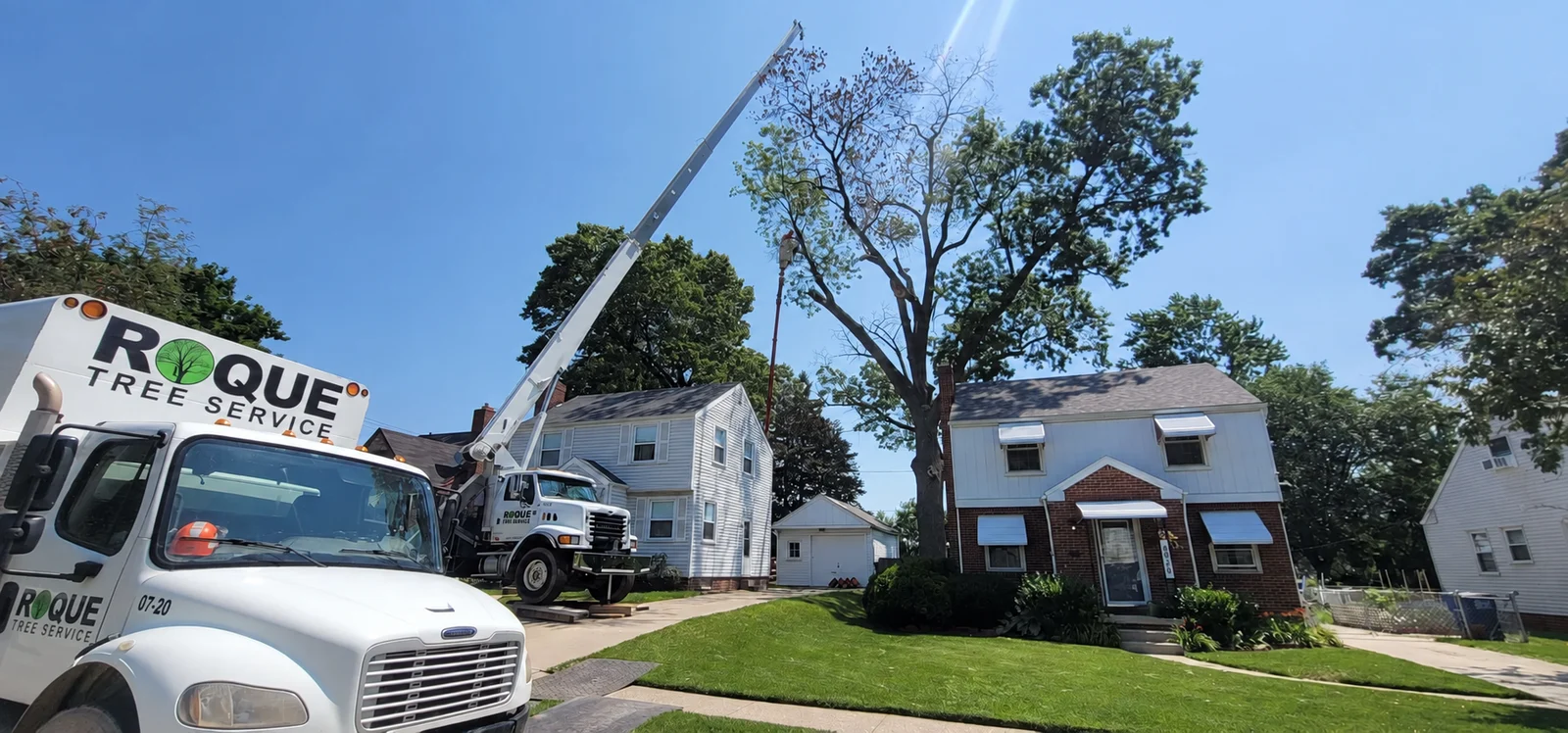
A crane is used to remove a Toledo tree when the tree cannot be safely climbed or dismantled in place — usually because it is dead (most often an ash killed by emerald ash borer), leaning over a house or garage, boxed in by lines and structures, or simply too large to lower piece by piece. The crane lifts sections straight up and out, which is faster, puts no climber in a dead tree, and protects what is underneath.
When does a tree removal need a crane instead of a climb?
A crane is required when one of four conditions is present: the tree is dead or brittle, there is a target under the drop zone, there is no safe rigging point or ground access, or the tree is beyond the reach of a bucket truck. Any one of these turns a routine climb into a crane job. Two or more usually make the decision obvious on the first site visit.
The first condition is the most common one in Northwest Ohio. Emerald ash borer was detected in Northwest Ohio in 2003, and white and green ash typically die three to six years after infestation, according to the Ohio Division of Forestry's invasive-insects guide. That means the region's standing dead ash have been drying and cracking for a decade or more. A climber ties into the top of a tree, and on a dead ash the top is the part that fails first. Nobody should be in that tree. A crane holds each section from above before the cut is made, so the wood never has to carry a person's weight or swing on a rope.
The second condition is what sits underneath. A live silver maple in an open yard can be dismantled from the top down with ropes, lowering each piece to the ground. The same tree leaning over a garage, a sunroom, a pool or a neighbor's fence has no drop zone. Every piece would have to be rigged and swung clear, and a single miscalculated swing lands on the roof. Lifting the piece vertically removes the swing entirely.
The third condition is access and rigging. Climb-and-rig removal needs a sound crotch above the piece being cut to run the lowering line through, and a clear path on the ground for the chipper and loader. A tree boxed in by a house on one side, the service drop on another and a fence on the third often has neither. A backyard tree 60 feet from the street behind a four-foot gate cannot be reached by a bucket truck at all, and a crane parked in the street or driveway can boom over the house to it.
The fourth condition is size. A bucket truck of the class used in residential tree care works to roughly 55 to 75 feet of height and needs a firm, level place to set up within that reach. Silver maple, the most common big tree in Toledo's older neighborhoods, matures at about 80 feet tall and 60 feet wide, per the Ohio DNR species page. Once the crown is above the bucket and the trunk sections are too heavy to lower by hand, the crane is the equipment that fits. The large-tree size guide gives the thresholds by trunk diameter and height.
| Situation | Climb and rig | Bucket truck | Crane | Grapple-saw truck |
|---|---|---|---|---|
| Dead ash over an open lawn, 24 in DBH | No — no reliable tie-in on dead wood | Yes, if the truck can reach the whole crown from firm ground | Yes — the safest fit; nobody in the tree | Yes, if reach allows and there is room for the truck |
| Live silver maple, 30 in DBH, leaning over a garage | Possible but slow; every piece must be swung clear of the roof | Partial — the bucket cannot lower heavy leaders over the roof | Yes — the typical answer; each piece lifted vertically | Yes for the crown; trunk sections usually need a crane |
| Oak boxed in by the service drop, house and fence | Only after the utility drops the service line; limited rigging points | No — no setup position | Yes — boom over the house from the drive or street | Limited by the same setup problem |
| 40 in cottonwood in an open yard, nothing underneath | Yes — a sound tree with a drop zone is a climb job | Yes for the crown | Optional — faster, not required | Yes |
| Backyard tree 60 ft from the street behind a 4 ft gate | Yes if sound; all wood carried or winched out by hand | No — cannot get to it | Yes — the crane lifts sections over the house to the street | No — same access limit as the bucket |
The point of the table is that a crane is a response to conditions, not a badge of a big job. The crane-assisted removal service page covers what to send for an estimate; the tree removal page covers large and complex removals that may or may not need one.
How does a crane pick plan work?
A pick plan is the sequence of lifts that takes a tree down in sections the crane can safely hold at the distance it has to reach. It is built from three numbers — the weight of each section, the radius from the crane's center pin to the pick point, and the crane's rated capacity at that radius — plus a rigging point, a cut sequence and a landing zone. The operator and the climber or grapple operator agree on it before the first cut.
Weight comes first. Green wood is heavy because it is mostly water. Using green-wood density figures from the USDA Forest Products Laboratory's Wood Handbook , a freshly cut silver maple log weighs roughly 45 pounds per cubic foot, green ash roughly 48, and red oak roughly 64. An 8-foot section of 30-inch-diameter silver maple trunk is about 39 cubic feet of wood — call it 1,700 to 2,000 pounds with bark. The same section of red oak is closer to 2,500 pounds. A crown section with limbs and leaves is lighter per foot of trunk but bulkier, and its weight is estimated from the trunk diameter at the cut and the spread of the limbs above it. Estimators round up.
Radius comes second. Every crane has a load chart: a table of the maximum load it can lift at each boom length and angle. The further the pick point is from the crane, the less the crane can hold. A crane that lifts 10 tons at 20 feet may be rated for a fraction of that at 80 feet with the boom reaching over a house. The operator sets the crane where the heaviest pick lands inside the chart with margin, and if that position is in the street, the job needs a right-of-way permit (below).
The rigging point is where the sling attaches. The climber, working from the crane's man basket where the tree is too dead to climb, or from the tree itself where it is sound, chokes a sling around the section above its balance point so it hangs level when it is cut free. The operator takes up tension — enough to hold the piece, not enough to lift it before the cut — and the cut is made. The section rises, swings clear of the house under the operator's control and is set down in the landing zone, where the ground crew unhooks it and starts cutting it up. Then the next pick.
The industry standard that governs all of this is ANSI Z133, the safety standard for arboricultural operations, whose crane section covers pre-lift planning, communication between the operator and the climber, and the conditions under which a climber may be lifted by the crane. Crane operation on a construction site falls under OSHA's cranes and derricks rule at 29 CFR 1926 Subpart CC, which requires operator certification or qualification, and OSHA's 2021 inspection guidance for tree care and tree removal operations is the document its inspectors use for tree jobs. Ask any crew using a crane who the signal person is and how the operator and climber communicate — hand signals, radio or both.
| Pick-plan item | Who owns it | What it decides |
|---|---|---|
| Section weights | Climber / crew lead | How many picks, where each cut goes |
| Crane position and radius | Operator | Whether the heaviest pick is inside the load chart; whether the crane sits in the street |
| Load chart check | Operator | The capacity margin at the furthest, heaviest pick |
| Outrigger pads and ground protection | Operator / ground crew | What protects the driveway, lawn and any buried utilities |
| Rigging point and sling choice | Climber | Whether each piece hangs level and clears the house |
| Cut sequence | Climber and operator together | Top-down order, which limbs come off first, where the trunk is bucked |
| Landing zone | Ground crew | Where sections are set, chipped and loaded; what stays clear |
| Signal person and communication | Crew lead | Who tells the operator to lift, hold, swing and set |
| Vehicles out, gates open, pets in | Homeowner | Whether the crew can set up on arrival |
| Neighbor permission for setup or drop zone | Homeowner | Whether the neighbor's drive can be used, in writing |
What changes when the crew owns the crane instead of renting one?
Four things change: the wait, the price, who is operating, and who is accountable. A crew that rents a crane books it from a rental yard when the yard has one free, pays a daily rate plus a subcontracted operator, and runs the job with a person at the controls who did not plan it. A crew that owns its crane schedules the job on its own calendar, at its own cost, with an operator who works with the climber every week.
the partner crew, the crew behind this site, owns its cranes and works both Ohio and Michigan. Here is what that changes.
The wait. Rental cranes in a metro the size of Toledo are shared with construction, roofing and HVAC contractors. After a windstorm, every one of them wants the same cranes on the same days. A crew that rents may quote your dead ash this week and pick it next month. A crew that owns its crane can put a storm job on tomorrow's schedule, because the only calendar that matters is its own.
The price. A rented crane carries a daily or half-daily minimum, a transport charge each way, and the operator's rate, and the crew marks all of it up. Nationally, published crane surcharges on tree removal run from a few hundred dollars for a short pick to several thousand dollars for a full day with a large unit, per Angi's 2026 tree removal cost survey. An owned crane still costs money to run, but there is no rental minimum, no transport surcharge and no markup on someone else's invoice, so a two-hour crane job can be priced as a two-hour crane job.
The operator. On a tree pick the operator matters more than on almost any other crane job, because the load is a living or dead tree section whose weight is estimated, not stamped on a crate. An operator who lifts trees every week reads the tension in the line, knows when a piece is about to release, and talks with the climber in the same shorthand every time. A rental-yard operator may be excellent at setting trusses and be seeing a tree pick for the first time.
The liability. With a rented crane there are two companies on your property, two certificates of insurance, and two versions of what happened if something goes wrong. Ask a crew that rents which policy covers a dropped section — the tree company's general liability or the crane company's — and listen to how long the answer takes. With an owned crane there is one company, one policy, and one name on the estimate. The planning guide's verification section explains how to check that certificate.
None of this means a rented crane is unsafe. Many good crews rent, and a properly planned pick with a rental unit is a properly planned pick. It means that the buyer's outcome — how soon, at what price, with whom accountable — is different, and worth asking about before signing.
What does crane tree removal cost in Toledo?
A crane removal in the Toledo area is priced from four drivers: trunk diameter, height, access, and condition — with the crane itself adding a setup cost that is spread across the job. Published national ranges put a 60-to-80-foot tree at roughly $800 to $1,500 and a tree over 80 feet at $1,000 to $2,000 before access, crane or disposal, with difficult access adding 25 to 50 percent and large trees near power lines reaching $10,000, per Angi (July 2026). Toledo estimates are made on site; the table below shows how the drivers combine.
The table is a rule of thumb for how the cost drivers stack, shown as multiples of a simple removal — a sound 12-to-20-inch tree in an open yard. Your estimate replaces it with a real number.
| Trunk diameter (DBH) | Open yard, climb or bucket | Tight access, climb and rig | Over a structure or dead, crane | Street-only setup, crane plus right-of-way permit |
|---|---|---|---|---|
| 12–20 in | 1.0× (baseline) | 1.3–1.5× | 1.8–2.5× | 2.2–3× |
| 20–30 in | 1.5–2× | 2–2.5× | 2.5–3.5× | 3–4× |
| 30–40 in | 2–3× | 3–4× | 3.5–5× | 4–6× |
| 40 in and over | 3–4× | 4–5× (rarely practical) | 5–7× | 6–8× |
A Toledo example. Take a live silver maple in the Old West End, 30 inches DBH and about 70 feet tall, with two co-dominant leaders and one of them over the detached garage. The yard is 35 feet wide with the house on one side and the neighbor's fence on the other. A climb-and-rig removal is possible but slow: every piece over the garage would be rigged and swung, and the trunk sections are too heavy to lower by hand. A crane set in the driveway can reach the whole crown in six to ten picks and have the tree on the ground by early afternoon. Against the table, that is a 30-to-40-inch tree in the "over a structure" column — roughly 3.5 to 5 times the cost of a small open-yard removal — and the crane is what makes it a one-day job instead of two. Stump grinding, hauling and the permit if the crane had to sit in the street are line items on top; the cost resource breaks each one out.
The crane is often the cheaper option, not the expensive one. A two-day climb with three people rigging over a roof costs more in labor than a one-day crane job with the same crew, and a crew that owns its crane does not have to pass through a rental minimum to get there. Ask every estimator to state the method, the crew size and the expected duration next to the price, and compare the totals on the same scope. The planning guide's section on what belongs in a written estimate gives the checklist.
Do you need a permit to put a crane in a Toledo street?
Yes, when the crane or any part of the operation occupies the public right-of-way — the street, tree lawn or sidewalk — the City of Toledo's Division of Transportation issues a right-of-way permit for the work, and the crew, not the homeowner, applies for it. The city's right-of-way opening permit application (revised September 2025) is the current form. Ask the crew who is pulling the permit, how many days of lead time it needs, and whether a lane closure or full closure is planned.
The right-of-way also contains the city's trees. Toledo manages more than 90,000 public trees, per the city's street trees page, and Toledo Municipal Code Chapter 917 governs them. TMC 917.01 requires a permit from the Commissioner of Parks, Forestry and Open Space Planning to plant, treat or remove a public tree; 917.02 covers conditional permits with replacement planting; and 917.05 protects public trees from damage, including a rule that no excavation or driveway work may occur within five feet of a public tree without a permit. A crane outrigger set on the tree lawn beside a city maple is exactly the kind of thing 917.05 is written for, and the city's Street Trees FAQ is clear that unauthorized pruning or removal of a street tree violates the chapter. If the tree you want removed is itself on the tree lawn, it is the city's tree: report it through Engage Toledo at 419-936-2020 rather than hiring a crew to take it down.
A private tree on private property needs no city permit in Toledo. The permit question is only about where the crane sits and what it touches. In the suburbs, the same logic applies with different offices: the Sylvania, Maumee and Perrysburg pages give each city's ordinance chapter and street-tree authority.
Across the Michigan line the roads outside a city belong to the Monroe County Road Commission, and the MCRC states that any work proposed to take place within the MCRC right-of-way requires a permit; its permit office is at 734-240-5132. A crane parked on Lewis Avenue in Temperance or Sterns Road in Bedford Township for a residential pick is work in the MCRC right-of-way. The Ohio-versus-Michigan guide lays out the rest of the differences.
What happens on crane day?
The crane arrives first, sets its outriggers on pads, and does nothing else until the pick plan is confirmed on site; the tree is then taken down top-first in a sequence of lifts, and the ground crew chips and loads as each section lands. On a typical Toledo residential job, the crane is set by mid-morning, the last pick is made by early afternoon, and the crew is cleaning up by the end of the day.
Arrival and setup. The crane, chipper truck and log truck arrive together or in sequence. If the crane sits in the street, cones and signage go out per the permit, and a flagger controls traffic if the closure requires one. The operator walks the setup position, checks for the outrigger footprint and for anything underneath — a septic tank, a buried gas line, an irrigation main — then extends the outriggers onto mats. On a driveway the mats spread the load across the slab; on a lawn they limit rutting. The crane levels itself and the boom goes up.
The first pick. The climber goes up in the man basket or, on a sound tree, climbs to the first rigging point. The first pick is usually a crown section or the top of a dead ash: light, high and furthest from the crane, so it tests the radius and the communication before the heavy work. The sling goes on, the operator takes tension, the cut is made, and the piece lifts clear and swings out to the landing zone.
Section sizes. The operator and climber size each pick to what the crane can hold at that radius with margin. On a big silver maple that may mean whole leaders of 2,000 to 3,000 pounds coming off in one lift; on a long reach over a house it means smaller pieces and more picks. Fewer picks is faster but never at the expense of the chart.
The ground flow. As each section lands, the ground crew unhooks it, limbs it, feeds brush to the chipper and bucks the trunk wood to loader length. The chip truck and log truck fill through the day. If you are keeping firewood, say so in the estimate, and the wood is left at the agreed size in the agreed place.
Your part. Vehicles out of the driveway the night before, gates unlocked, pets inside, a phone that you answer. Stay out of the work zone — including for photos — and use the crew lead as the single point of contact. Tell the neighbors the day before if the crane will be in the street; it is loud, it is large, and a heads-up prevents most complaints.
At the end. The crew rakes the landing zone, blows off the driveway, pulls the mats and checks the setup area with you. Stump grinding is usually a separate visit with a separate machine. Compare what you see with the written scope before the crew leaves.
Which trees end up as crane jobs in Northwest Ohio?
Four species account for most crane removals in the Toledo corridor: dead ash, silver maple, cottonwood, and large oaks standing over houses. Each is a crane job for a different reason, and the dead ash and problem trees guide covers each in depth.
Dead ash. The emerald ash borer arrived in Southeast Michigan in 2002 and Northwest Ohio in 2003, and by 2016 it had been found in every Ohio county, according to the Ohio Division of Forestry. Its larvae girdle the tree under the bark, and white and green ash die within three to six years. A dead ash is not climbed. It is a bucket-truck job where the truck can reach and a crane job where it cannot, and because the wood is brittle and the picks are planned to avoid shock-loading a rotten trunk, it is frequently a more careful job than a live tree of the same size.
Silver maple. Ohio DNR describes silver maple as reaching about 80 feet with a 60-foot spread, with brittle wood that suffers "significant storm damage throughout its life". It was planted by the thousands in Toledo's early-twentieth-century neighborhoods because it grows fast, and a century later those trees are 30 to 48 inches in diameter with multiple co-dominant leaders, at least one of which is over a garage. It is the single most common big-tree crane job in the city.
Cottonwood. A wet-site tree along the Maumee, the Ottawa River and the Monroe County drains, cottonwood grows fast, gets very large, and drops limbs. Its wood is soft and heavy when green, and its size near structures usually means crane picks rather than rope work.
Oaks over houses. Red and white oaks are sound, dense and heavy; the reason they become crane jobs is that a 36-inch oak standing 15 feet from a house has no drop zone, and each section weighs half again what the same-size maple would. On the Michigan side there is a seasonal complication: the Michigan DNR asks that oaks not be pruned or wounded between April 15 and July 15 because the beetles that spread oak wilt are active and red oaks can die within weeks of infection. Removing a dead oak is fine any time; wounding the live oaks around it in that window is the risk.
Is a crane job different across the Michigan line?
The tree, the crane and the pick plan are the same; the permit office, the utility and the insurance rules change. In Monroe County, road right-of-way permits come from the Monroe County Road Commission rather than a city, DTE trims only pole-to-pole lines and leaves the service drop to the homeowner (per DTE's published guidance; emergency line 800-477-4747), and Michigan's insurance regulator publishes a homeowners guide that lists tree removal as optional coverage with a standard $500 limit. On the Ohio side, FirstEnergy's Toledo Edison prunes for its lines under its easement rights and states that storm debris and large wood at the base of the tree are the property owner's responsibility.
The reason most Toledo crews do not cross the line is not the law — there is no state tree-service license in either state — but insurance certificates written for one state, unfamiliar road-commission permits and drive time. The partner crew for this site is licensed in both Ohio and Michigan and treats Bedford Township and Temperance as part of the same service area as Sylvania. The Ohio-versus-Michigan guide has the full comparison, with the corridor municipality list.
Frequently asked questions
Will the crane damage my lawn or driveway?
A crane sets on four outriggers, and each outrigger sits on a pad or mat that spreads the load. On a driveway the crew places mats over the slab; on a lawn it uses mats or plywood to limit rutting. Some marking from a heavy machine is normal on soft ground, and the estimate should say what protection is used and what restoration, if any, is included.
Do I need to be home on crane day?
Not usually, but you need to be reachable. Vehicles must be out of the setup area before the crane arrives, gates unlocked, and pets inside. The crew will want a phone number for the person who can make a decision if something on site differs from the estimate.
Can a crane reach a backyard tree from the street?
Often, yes. That is the main reason a crane is chosen for a tree behind a house: the boom reaches over the roof and lifts sections out to the street without any machine crossing the yard. Reach depends on the crane's load chart at that radius; a heavy pick far from the crane may need a larger crane or smaller sections.
How big is "too big to climb"?
There is no single number. Size alone rarely rules out climbing; a dead trunk, a target under the drop zone, or no safe place to lower sections does. As a rule of thumb used on this site, a tree past about 24 inches in trunk diameter or 60 feet tall with something valuable underneath is a crane candidate. See the large-tree size guide.
Does homeowners insurance pay for a crane?
When a covered peril such as wind drops the tree onto a covered structure, removal is part of the damage claim, and the method the crew needs to use, including a crane, is part of that cost. Preventive removal of a standing tree is not covered. Details and the debris caps are in the storm and insurance guide.
Is a crane safer than climbing?
For a dead or structurally compromised tree, yes: nobody ties into the tree, and each section is held by the crane before it is cut rather than swinging on a rope. For a sound tree in an open yard, a climb-and-rig removal is also safe and may be the better fit. The method follows the tree, not the other way around.
How long does a crane removal take?
Most residential crane removals in the Toledo area are a single-day job: setup in the morning, picks through midday, chipping and log loading in the afternoon. A very large tree, a long reach, or a street closure that limits the working window can push it to two days. The estimate should state the expected duration.
Can the neighbor's driveway be used for the crane?
Only with the neighbor's written permission, arranged before the day. Crane outriggers exert high point loads, and the crew will want to protect the neighbor's slab the same way it protects yours. If the only setup position is in the street, a right-of-way permit is the alternative.
Ready to get a quote?
Pick the page that matches the job. Each one links back to this guide when you want the planning detail.
- Crane-assisted tree removal — dead, leaning, or boxed-in trees that need to be lifted out.
- Tree removal — large and complex removals, with or without a crane.
- Storm and urgent tree service — a tree on a house, a car or a line.
- Stump removal — grinding after the tree is down.
- Tree trimming — when the tree is staying.
- Brush and land clearing — lots, fencerows and overgrowth.
Sources
- Ohio DNR Division of Forestry, Invasive Insects of Ohio (EAB dates and mortality window).
- Ohio DNR, Silver maple species page.
- Toledo Municipal Code 917.01, 917.02, 917.05.
- City of Toledo, Street trees and Street Trees FAQ; Right-of-way opening permit application.
- Monroe County Road Commission, Residential permits.
- Michigan DNR, Delay pruning oaks until mid-July (April 13, 2026).
- FirstEnergy, Homeowner rights and responsibilities; DTE, Your questions on DTE tree trimming answered.
- Michigan DIFS, Homeowners Insurance Guide.
- OSHA, Inspection guidance for tree care and tree removal operations (June 30, 2021); ANSI Z133 (Safety Requirements for Arboricultural Operations); 29 CFR 1926 Subpart CC.
- Angi, How much does tree removal cost? (updated July 8, 2026).
- USDA Forest Products Laboratory, Wood Handbook (FPL-GTR-282), green wood density tables.