Large and complex removals · Toledo, OH and Monroe County, MI
Tree removal in Toledo, Ohio
Tree removal in Toledo starts with three questions: how big is the trunk, what is underneath it, and is it alive. Those decide whether the tree is climbed and rigged, reached with a bucket truck, or lifted out with a crane — and they drive the estimate more than height does. A tree between the sidewalk and the curb belongs to the city and is not yours to remove; a tree in your yard needs no city permit.
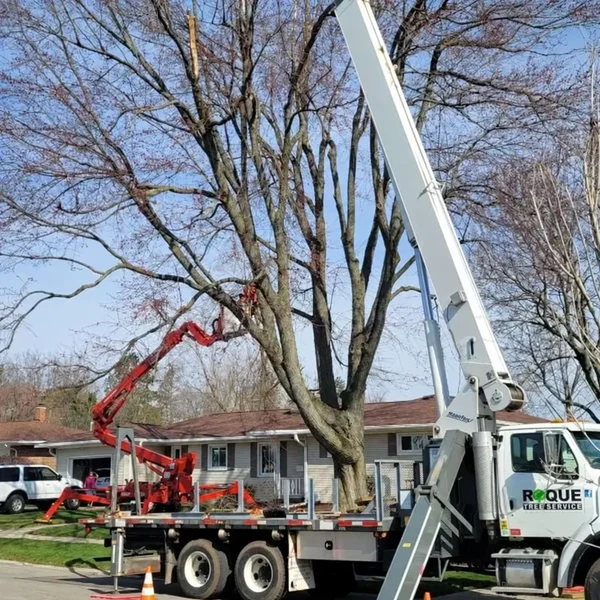
Which trees does this page cover?
Planned removals — the ones you schedule, not the ones a storm schedules for you. That means trunks past about two feet across, dead ash killed by the emerald ash borer, silver maples and oaks leaning over a roof or garage, trees standing where a driveway, addition or pool is going, and trees whose lean has changed since spring. Small trees are the same process with fewer decisions; a tree that is already on the house is a different page — see storm and urgent tree service.
Removals for this site are performed by the partner crew, a BBB-accredited A+ partner crew in business since 2010 that owns the cranes it uses and is licensed in both Ohio and Michigan. That last point matters for anyone in Bedford Township, Temperance or Lambertville: the same crew and the same crane cross the line, so a Monroe County job is not handed off to someone else.
Dead ash deserves its own sentence. The emerald ash borer reached Northwest Ohio in 2003, and an infested ash dies within three to six years; the trees standing dead in Toledo yards today are brittle from the top down and are the trees nobody should climb. They are removed from the ground — bucket where it reaches, crane where it does not. The dead-ash guide explains why.
How big is "large", and what method does that mean?
Trunk diameter at chest height (DBH) predicts the method better than height does, because it sets how much each section weighs. Wrap a tape around the trunk at 4.5 feet and divide by 3.14; that is your DBH. Below about 12 inches almost any crew climbs or fells the tree whole. Between 12 and 24 inches the tree is climbed and rigged or reached with a bucket truck. Past 24 inches, with something valuable underneath, the sections are heavy enough that a crane is the usual answer; past 36 inches every leader is a multi-ton pick. The full thresholds, including what changes when the tree is dead, are in the large-tree size guide.
| Trunk diameter (DBH) | Open yard, sound tree | Over a structure or line | Dead or hazardous |
|---|---|---|---|
| Under 12 in | Climb or fell whole | Climb and rig | Bucket truck, or cut from the ground |
| 12–24 in | Climb and rig, or bucket truck | Climb and rig with lowering lines | Bucket truck; crane if the bucket cannot reach |
| 24–36 in | Climb and rig with a larger crew | Crane is the usual fit | Crane required |
| Over 36 in | Climb possible; crane is faster and often cheaper | Crane required in practice | Crane required, planned from the ground |
What drives the cost of a tree removal in Toledo?
Size, what is underneath, whether the tree is alive, and how a truck gets to it. Those four set the method, and the method sets the price. The table lists every driver an honest estimate accounts for and the direction it pushes. This page publishes drivers, not dollar figures: the partner crew has not supplied ranges for publication, and a number without the assumptions behind it is not comparable to anything. The cost resource walks through how the pieces combine, and the planning guide shows how to compare two estimates like for like.
| Driver | Why it matters | Direction |
|---|---|---|
| Trunk diameter (DBH band) | Sets section weight, crew size and the day’s length | Up with every band |
| Height and reach | Decides whether a bucket truck can reach the whole crown from firm ground | Up when a bucket cannot reach |
| What is underneath | A roof, fence, pool or line means every piece is lowered or lifted, never dropped | Up sharply over a structure |
| Dead vs live | A dead ash cannot be climbed; the job becomes bucket or crane from the ground | Up for dead trees |
| Access | Gate width, slope, distance from the street, soft ground | Up as access narrows |
| Crane vs climb | A crane adds a machine and operator but cuts hours and risk on big trees | Either way — often down on the biggest trees |
| Haul vs leave the wood | Chipping and log hauling are labor and truck time | Down if you keep the wood |
| Stump grinding | A separate machine and visit | Separate line item |
| Right-of-way permit | Required when the crane or trucks occupy a Toledo street or a Monroe County road | Added as a pass-through |
| Utility involvement | A service-drop disconnect or line clearance before the crew can work | Adds scheduling, sometimes cost |
Do you need a permit to remove a tree in Toledo?
For a tree in your yard, no. For a tree in the tree lawn between the sidewalk and the curb, it is not your tree. Toledo Municipal Code 917.01 makes those public trees the city’s and requires a permit for any work on them; 917.05 bars excavation within five feet of a public tree without a permit, which catches stump grinding near the curb; and 917.99 sets the penalty. Report a dead or dangerous street tree through Engage Toledo at 419-936-2020 and the city inspects and removes its own trees — there are more than 90,000 of them. The one permit a private tree can trigger is a right-of-way permit from the city’s Division of Transportation when the crane or trucks must sit in the street; the crew applies for it and passes the fee through on the estimate.
Sylvania, Maumee, Perrysburg and Ottawa Hills each have their own tree chapter, and the Michigan side runs on Monroe County Road Commission permits for county-road right-of-way (734-240-5132). The Ohio vs Michigan guide lays out the differences; the location pages for Sylvania, Perrysburg, Maumee and Bedford Township carry each municipality’s rule.
What happens to the wood, brush and stump?
Three separate decisions, and each one should be a line on the estimate. Brush is chipped on site and hauled unless you want the chips for mulch. Trunk wood is either bucked and hauled, or bucked to firewood length and left stacked where the crew can reach — keeping the wood lowers the price, but a 30-inch oak produces more firewood than most households burn in years. The stump is its own machine and its own visit; see stump removal for grind depth, the OHIO811 / MISS DIG 811 locate, and what grindings are good for. If the removal was a crane job, say so — the crew that did the pick already knows the stump’s diameter and what is next to it.
What to send for an estimate
Six things let the crew tell you the method before anyone drives out: the property address (street and town — Ohio and Michigan estimates are scheduled differently); a wide photo of the whole tree from a safe distance, with the house in frame; your DBH estimate (circumference ÷ 3.14); what is directly underneath and beside the tree; the width of the narrowest gate or gap a machine would pass through; and whether the tree is in the yard or in the tree lawn. Add whether you want the wood, and whether the stump is part of the job. Photos do not replace the on-site look that sets the method and the number, but they decide who comes and what they bring. Request an estimate, or read the planning guide first.
Questions
Frequently asked questions
Do you remove dead ash trees?
Yes — dead ash is the most common large-tree removal in the Toledo area. Because a borer-killed ash cannot be safely climbed, it is taken down from the ground with a bucket truck or a crane, which is why the partner crew’s owned cranes matter for this species in particular.
Can you quote from a photo?
A wide photo with the house in frame lets the crew judge the method and bring the right equipment. The number itself comes from an on-site look, because access, what is underneath and the condition of the trunk cannot be read reliably from a photo.
Is stump grinding included?
It is a separate service and a separate line on the estimate. Ask for it when you request the removal so both are scheduled together; see the stump removal page for depth, locates and grindings.
Do you work in Michigan?
Yes. The partner crew is licensed in both Ohio and Michigan and serves Monroe County — Bedford Township, Temperance, Lambertville, Erie and the City of Monroe — with the same crew and cranes it uses in Toledo.
Will you pull the permit if the crane has to sit in the street?
The crew applies for the Toledo right-of-way permit, or the Monroe County Road Commission permit on the Michigan side, and passes the fee through on the estimate. The homeowner does not deal with the city or county directly.
Can I keep the firewood?
Yes, and it lowers the price because hauling is labor and truck time. Say so when you request the estimate; the crew bucks the trunk to length and stacks it where a truck can reach.
Not ready to talk yet?
Planning guides for tree removal
The guide behind this page: The complete Toledo tree-removal planning guide.
Related services
- Crane tree removal — Sections lifted straight up and out for dead ash, trees over a roof, and trunks too big or too boxed-in to rig — by a crew that owns its cranes.
- Stump removal — Large-diameter grinding after a removal — depth, the 811 locate, roots and grindings, and the TMC 917.05 rule near street trees, on both sides of the line.
- Storm and urgent tree service — The order of operations when a tree is down: utility first, then a crane crew that works both sides of the line — with the insurance facts that decide who pays.
Where this work is done
Toledo · Sylvania · Perrysburg · Bedford Township, MI · all Ohio and Michigan municipalities
Request a tree removal estimate
Roque Tree Service · BBB A+ · In business since 2010 · 33 Facebook reviews, 100% recommend
Partner crew licensed in both Ohio and Michigan. Owns the cranes it uses.