City of Bowling Green · Wood County
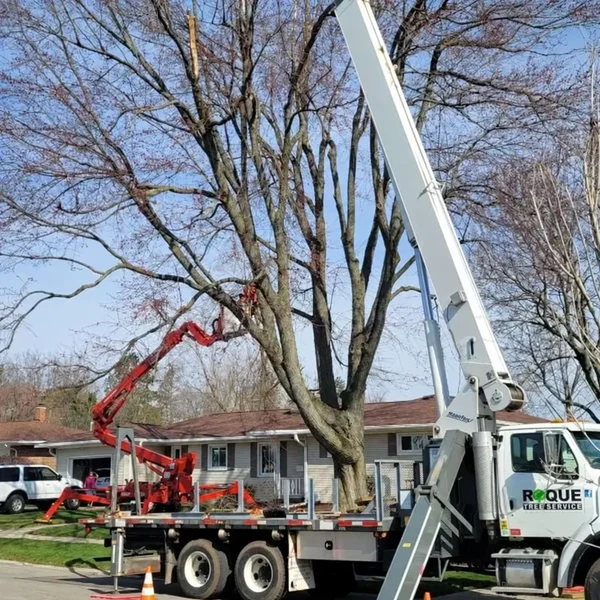
Crane & Large Tree Removal in Bowling Green, Ohio
Bowling Green has its own electric utility and city arborist approval process for public trees. Contact the municipal utility for line conflicts, and account for street-tree planting standards when removal includes replacement. Toledo Edison rules should not be assumed to apply to a city electric account. Request an estimate to confirm availability and the appropriate scope for your address.
Which tree rules apply in Bowling Green?
Bowling Green §99.03 requires written permission from the city arborist for covered public-tree work. The city’s tree authority and public-tree permit provisions must be checked before removing a tree in a street lawn or using that area as part of the work site. A private-tree estimate should identify whether a public tree is affected instead of assuming everything between the house and pavement belongs to the homeowner.
Source checked September 2026: City of Bowling Green tree and zoning provisions. City street-tree and development planting guidance provides additional local detail. Verify the current requirements for the actual parcel before work.
Property boundaries, retained trees and equipment access
Bowling Green has a municipal Electric Division, an important exception to a blanket Toledo Edison assumption. Its urban-forestry guidance also explains why replacement planting deserves attention: compacted or disturbed ground and high-pH clay soils can limit suitable species, and red maples may develop chlorosis. The city specifies different minimum tree-lawn widths for small, medium and large street trees. Those are public planting standards, not a survey of backyard species. If removal is followed by replacement, obtain city guidance for a street tree rather than automatically buying the same species.
Coordinate the electric utility before cutting
Check Bowling Green’s municipal Electric Division before assuming Toledo Edison. The city’s tree-and-power-line guidance directs nonemergency concerns through its urban-forestry process. A utility clearance decision does not automatically include full private-tree removal, stump grinding or hauling.
Do not approach a fallen wire or a tree touching it. Keep people clear, call 911 for an immediate hazard and contact the electric utility. A tree-removal estimate is not authorization for a private crew to work around an energized conductor.
The city’s planting guidance says its Electric Division trims near power lines on a three-to-five-year rotation. It recommends smaller trees beneath overhead wires. Contact the city about an immediate conflict rather than assuming the next routine cycle covers a private removal.
Use weather history without guessing the tree’s condition
Toledo Executive Airport NWS observations are the regional reference used here. Wood County Regional Airport (1G0) is closer to Bowling Green, but a usable NWS observation-history page for that field was not available during this review; Toledo Executive is not described as the nearest airport. The March 13, 2026 regional wind report recorded 61 mph at Toledo Express and 69 mph at Toledo Executive. Those are airport measurements, not claimed gusts at a Bowling Green property. A regional storm record cannot tell you whether an individual tree is safe.
Photograph a new lean, split stem, hanging limb or lifted soil only from a safe position. Species identification, decay, attachment strength and access matter more than height alone. An on-site assessment determines whether preservation, pruning or removal is appropriate.
The NWS also documents the June 29, 2012 derecho and June 13–14, 2022 severe storms. These are regional records, not evidence that every listed town suffered the same winds or damage. Use them to plan an inspection of pre-existing defects after severe weather, not to assign a tree’s failure date or diagnose it remotely.
Tree species and the property’s working space
Bowling Green’s planting guidance makes soil and growing space central: high-pH clay and disturbed ground can be unsuitable for some species, including red maple prone to chlorosis. A declining red maple therefore needs a condition assessment rather than a removal decision based only on leaf color. Larger oaks or other shade trees need enough planting space, while a narrow tree lawn or overhead line calls for a different replacement choice. These city standards explain why a front-yard replacement and a backyard crane removal need separate site decisions.
An illustrative Bowling Green removal assessment
For a large maple over a garage, show the estimator the service wire, driveway and any public street tree before discussing a crane. Coordinate necessary electrical work with the municipal utility. A street lawn with an existing tree should not be treated as spare equipment space. The written quote can separate the private removal, utility coordination, stump grinding and any city-approved replacement. This is an illustrative Bowling Green access problem, not a claim that a specific project has been completed.
See the crane removal guide for how reach, lifting radius and access affect the assessment. Compare crane removal with sectional tree removal instead of choosing equipment from tree height alone.
What to send for a Bowling Green estimate
Send the street address, a full-tree photo, a view of the trunk base and pictures showing the route from the street. Include approximate trunk diameter, nearby roofs or fences, overhead wires, driveway width and surface, and any city notice or approved landscape plan. State whether you want logs removed, brush chipped, the stump ground and the ground restored. Mark those as separate quote items so the finished scope is clear.
Arrange 811 utility locating before stump grinding or other digging, and tell the crew about private underground systems. An estimate based on photos remains subject to a site assessment. Use the tree-removal cost guide for planning context and request an estimate for your Bowling Green address to confirm availability and the appropriate next step.
Questions
Bowling Green questions
Should I call Toledo Edison for a Bowling Green line conflict?
Check the property’s utility bill. Bowling Green operates its own Electric Division, and its published guidance directs nonemergency tree-and-line questions through the city. Do not assume the utility serving another Toledo-area town serves this address.
Can a crane remove a tree over my Bowling Green house?
Possibly, but access, lifting radius, ground support, overhead wires and the tree’s condition must be assessed first. Photos help prepare an estimate; they do not establish a safe setup or guarantee a crane is needed.
Does the estimate include stump grinding and hauling?
Ask for those items explicitly. Complete removal, log hauling, brush cleanup, stump grinding and surface restoration can be separate parts of the scope.
Not ready to talk yet?
Big-tree guides for Bowling Green property owners
Services in Bowling Green
- Crane tree removal — Sections lifted straight up and out for dead ash, trees over a roof, and trunks too big or too boxed-in to rig — by a crew that owns its cranes.
- Tree removal — Planned removal of big trunks, dead ash and trees over structures — climbed, bucketed or lifted out by crane, on either side of the state line.
- Stump removal — Large-diameter grinding after a removal — depth, the 811 locate, roots and grindings, and the TMC 917.05 rule near street trees, on both sides of the line.
Nearby
Waterville · Perrysburg · Walbridge · all Ohio and Michigan municipalities
Request a tree removal estimate in Bowling Green
Roque Tree Service · BBB A+ · In business since 2010 · 33 Facebook reviews, 100% recommend
Partner crew licensed in both Ohio and Michigan. Owns the cranes it uses.