Village of Whitehouse · Lucas County
Crane & Large Tree Removal in Whitehouse, Ohio
Whitehouse requires authorization for public-tree removal and regulates excavation within ten feet of public trees. Protecting a retained street tree can therefore affect a private removal, stump work and driveway access. Its surveyed street-tree population and backyard shade trees should not be confused. Request an estimate to confirm availability and the appropriate scope for your address.
Which tree rules apply in Whitehouse?
Whitehouse §167.05 requires Tree Commission authorization before removing or injuring a public tree. Public-tree planting, pruning, bracing, cabling and related work also have written approval requirements. Excavation for a ditch, trench or driveway within ten feet of a public tree needs a municipal-administrator permit. Those provisions matter when a private-tree removal also includes stump grinding, a driveway repair or a crane setup beside a retained street tree.
Source checked September 2026: Village of Whitehouse tree and zoning provisions. September 2025 council packet and Tree Commission minutes provides additional local detail. Verify the current requirements for the actual parcel before work.
Property boundaries, retained trees and equipment access
The village’s August 2025 Tree Commission minutes report a survey of 626 street trees at 615 residences, with Callery pears accounting for 59 percent of that surveyed public-tree group. That is useful evidence about the surveyed street trees, not a census of backyard trees or a reason to assume every large removal is a pear. The village’s street-tree planting plan includes larger shade-tree choices. Identify the actual backyard tree and assess its condition before selecting a removal method. A public-tree planting requirement associated with new construction is a separate question from taking down an established private tree.
Coordinate the electric utility before cutting
Toledo Edison service in Whitehouse is documented by village utility expenditure records; verify the actual property account, particularly outside municipal boundaries. An aggregation supplier is separate from the utility maintaining the wires. FirstEnergy’s tree-safety guidance explains the utility’s vegetation-management role. Line clearance and a complete private-tree removal are different scopes. Have the utility assess any necessary disconnection before the crew plans cuts or crane lifts near wires.
Do not approach a fallen wire or a tree touching it. Keep people clear, call 911 for an immediate hazard and contact the electric utility. A tree-removal estimate is not authorization for a private crew to work around an energized conductor.
FirstEnergy’s removal policy says a tree between the pole and home may require a service disconnect; the owner remains responsible for the actual removal, and fees may apply. Routine line-maintenance crews leave larger wood, while emergency storm work does not include debris cleanup. Put hauling and stump grinding in the private quote.
Use weather history without guessing the tree’s condition
Toledo Express Airport NWS observations provide a nearby weather reference; the appropriate station varies with the parcel. The March 13, 2026 regional wind report recorded 61 mph at Toledo Express and 69 mph at Toledo Executive. Those are airport measurements, not claimed gusts at a Whitehouse property. A regional storm record cannot tell you whether an individual tree is safe.
Photograph a new lean, split stem, hanging limb or lifted soil only from a safe position. Species identification, decay, attachment strength and access matter more than height alone. An on-site assessment determines whether preservation, pruning or removal is appropriate.
The NWS also documents the June 29, 2012 derecho and June 13–14, 2022 severe storms. These are regional records, not evidence that every listed town suffered the same winds or damage. Use them to plan an inspection of pre-existing defects after severe weather, not to assign a tree’s failure date or diagnose it remotely.
Tree species and the property’s working space
The village survey’s high Callery-pear share describes street trees, not the large canopy trees behind houses. The Whitehouse street-tree master plan identifies oak and maple planting choices; it is a plan rather than a present-day census. When inspecting a large maple behind a home, distinguish the species and check attachments instead of assuming it behaves like a small ornamental pear. Retained trees along the driveway create an additional root-protection constraint.
An illustrative Whitehouse removal assessment
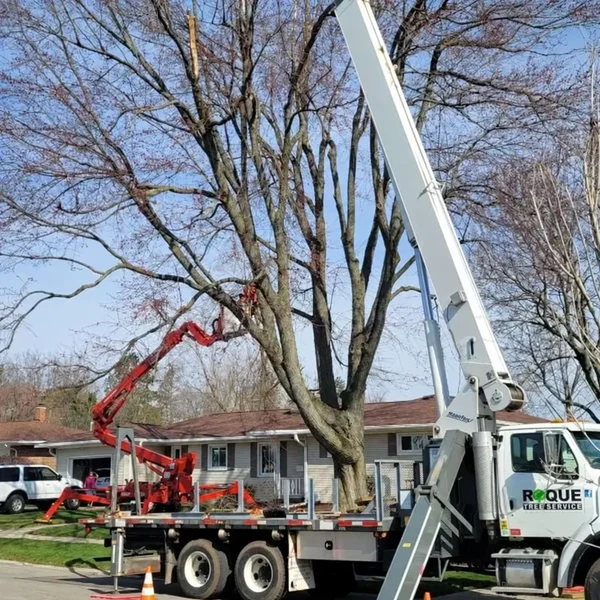
Imagine a large backyard maple whose easiest lifting route passes over a house, with a village street tree beside the driveway. The retained public tree is part of the access assessment: branches, roots and any nearby excavation need consideration before equipment arrives. A crane assessment should show the setup position, lifting radius and support surface. If stump grinding would approach the public tree, resolve the village’s excavation rule first. This example explains the approval sequence; it is not a claim about a completed Whitehouse project.
See the crane removal guide for how reach, lifting radius and access affect the assessment. Compare crane removal with sectional tree removal instead of choosing equipment from tree height alone.
What to send for a Whitehouse estimate
Send the street address, a full-tree photo, a view of the trunk base and pictures showing the route from the street. Include approximate trunk diameter, nearby roofs or fences, overhead wires, driveway width and surface, and any city notice or approved landscape plan. State whether you want logs removed, brush chipped, the stump ground and the ground restored. Mark those as separate quote items so the finished scope is clear.
Arrange 811 utility locating before stump grinding or other digging, and tell the crew about private underground systems. An estimate based on photos remains subject to a site assessment. Use the tree-removal cost guide for planning context and request an estimate for your Whitehouse address to confirm availability and the appropriate next step.
Questions
Whitehouse questions
Does stump work near a public tree need a separate check?
Yes. Whitehouse §167.05 specifically regulates excavation within ten feet of a public tree. Ask the village how that provision applies to the proposed stump or driveway work before proceeding.
Can a crane remove a tree over my Whitehouse house?
Possibly, but access, lifting radius, ground support, overhead wires and the tree’s condition must be assessed first. Photos help prepare an estimate; they do not establish a safe setup or guarantee a crane is needed.
Does the estimate include stump grinding and hauling?
Ask for those items explicitly. Complete removal, log hauling, brush cleanup, stump grinding and surface restoration can be separate parts of the scope.
Not ready to talk yet?
Big-tree guides for Whitehouse property owners
Services in Whitehouse
- Crane tree removal — Sections lifted straight up and out for dead ash, trees over a roof, and trunks too big or too boxed-in to rig — by a crew that owns its cranes.
- Tree removal — Planned removal of big trunks, dead ash and trees over structures — climbed, bucketed or lifted out by crane, on either side of the state line.
- Stump removal — Large-diameter grinding after a removal — depth, the 811 locate, roots and grindings, and the TMC 917.05 rule near street trees, on both sides of the line.
Nearby
Waterville · Monclova Township · Swanton · all Ohio and Michigan municipalities
Request a tree removal estimate in Whitehouse
Roque Tree Service · BBB A+ · In business since 2010 · 33 Facebook reviews, 100% recommend
Partner crew licensed in both Ohio and Michigan. Owns the cranes it uses.