Lucas County · the lakefront side of the metro
Crane & Large Tree Removal in Oregon, Ohio
Oregon regulates its trees through the right-of-way rather than a tree ordinance: the Street Department manages every tree in the public right-of-way, any work in that right-of-way needs a permit from the Department of Public Service under Chapter 712, and the city’s Construction Near Trees policy sets protection distances around its trees. A tree on your own lot is yours to remove without a permit. The big removals here are the lakefront and ditch-line cottonwoods — the fastest-growing, most brittle 100-foot trees in the county — and dead ash on the acre lots south of Navarre Avenue.
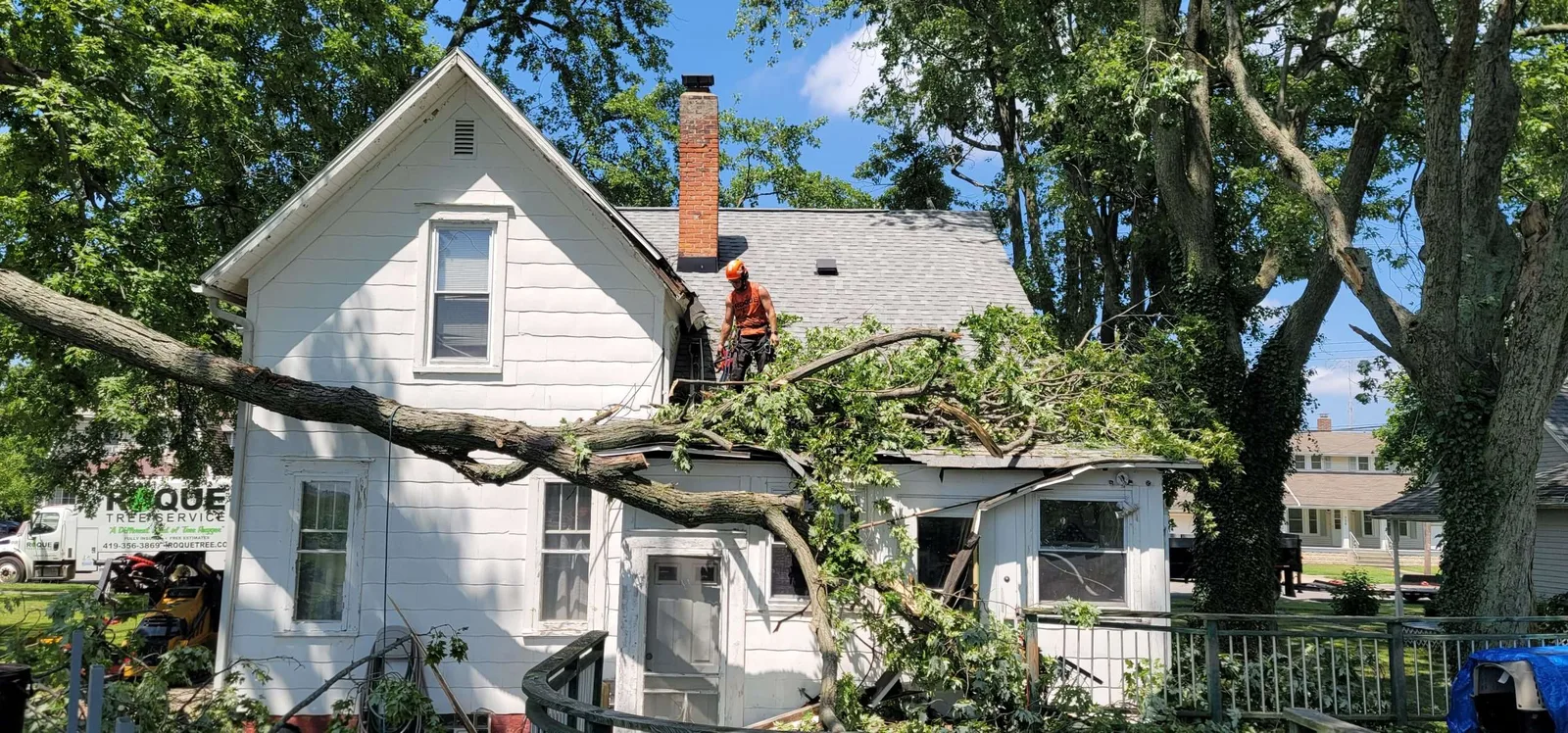
Who owns the tree, and which permit applies?
Oregon’s codified ordinances have no chapter titled “Trees.” Part Nine of the code — streets, utilities and public services — runs from Chapter 905 Streets through Chapter 915 Weeds, Grasses and Other Vegetation without a street-tree chapter, and the tree rules that do exist are attached to the right-of-way instead:
- Chapter 712, Right of Way. Anyone working in the public right-of-way needs a permit; 712.05 sets the general use rules (safety measures and barricades as the Director of Public Service requires, restoration within 30 days). The city’s Application to Work in the Right-of-Way (revised January 2024) is issued by the Department of Public Service, 5330 Seaman Road, 419-698-7047, and it says in terms: “If work is near any tree in the right of way, the city needs to be notified.”
- Policy — Construction Near Trees (version 1.16.24). The Street Department “manages trees in public right-of-ways and easements.” No excavation or root cutting within three feet of the bark of a tree up to 38 inches in circumference, and within a distance equal to the circumference — up to six feet — of a larger one; hand-digging is allowed closer if no root over two inches is cut; where the distance cannot be met, the contractor requests an inspection from the Street Department at 419-698-7016 (after hours, non-emergency dispatch 419-255-8443).
So the tree between the sidewalk and the curb — where Oregon has sidewalks; much of the city has open ditches instead — is the city’s, and a contractor does not remove it without the Street Department. A tree on your own lot is private and needs no city permit; Chapter 915 reaches private land only for weeds and unkept vegetation. Outrigger pads on a city tree lawn are fine under the policy; trenching for a stump grinder’s access is not, inside the protection distance.
| Item | Rule or fact | Source |
|---|---|---|
| Tree in the right-of-way | Street Department manages it; no work without the city; construction-near-trees distances apply | City policy · Ch. 712 |
| Private tree | No permit | Codified ordinances (no tree chapter) |
| Crane or rig in the road | Right-of-way permit from Public Service, 419-698-7047 | ROW application |
| Tree questions | Street Department 419-698-7016 | City policy |
| Electric utility | Toledo Edison (FirstEnergy), 888-544-4877 | FirstEnergy |
| Storm record | 2012 and 2022 derechos (Woodville, next door, lost power town-wide in 2022); 2026-03-13 windstorm, 69 mph at Toledo Executive | NWS Cleveland |
| Big-tree species | Eastern cottonwood on the lakefront and ditch lines; silver maple; willow; standing dead ash on the acre lots | ODNR |
Toledo Edison in Oregon
Oregon is Toledo Edison (FirstEnergy) territory, and on the east side a great deal of the distribution runs along open ditch lines through exactly the cottonwoods and willows that grow there fastest. The utility clears its own lines on its own cycle, leaves the wood, and does not remove a tree on request; FirstEnergy’s homeowner rights page puts storm debris and large wood on the owner. Wire down: 888-544-4877 first. A service drop through the crown is dropped or shielded before a pick. The Ohio vs Michigan guide compares this with DTE’s rule across the bay in Monroe County.
Oregon’s storm record: the lake side takes the wind first
Oregon fronts Maumee Bay and Lake Erie, and the wind off the water has nothing to slow it down. The June 13–14, 2022 derecho put a 60–70 mph swath across the metro and left Woodville, ten miles south-east, without power town-wide. The March 13, 2026 windstorm was measured at 69 mph at Toledo Executive Airport, the nearest station, and more than 600,000 Ohio customers lost power. The 2012 derecho is the benchmark. Cottonwoods are the tree those winds break: fast-grown, hollow-prone, shedding limbs and whole tops onto Bay Shore Road cottages and the houses along the ditches. A cottonwood that lost its top in March and is still standing in September is a removal to plan now. The storm history and insurance guide covers what a policy pays when one lands, and the emergency service page the first hour.
Which Oregon trees become crane jobs?
Cottonwood first, and it is not close. Eastern cottonwood is the fastest-growing big tree in Ohio, routinely 80–100 feet with a trunk four feet through, and its wood is weak, its crown is heavy, and it favors exactly Oregon’s ground — the lakefront, the ditch lines along Corduroy and Seaman Roads, the wet acre lots toward Pearson Metropark. A 100-foot cottonwood over a cottage on a narrow lakefront lot has no drop zone on any side: the house on one, the water on another, the neighbors ten feet away on the other two. That is a crane job from the road or the driveway, in picks, or it is not a safe job at all.
Silver maples on the older residential streets bring the same brittleness in a smaller package (the ODNR describes an 80-foot tree that takes “significant storm damage throughout its life”), and the acre lots south of Navarre Avenue are full of ash killed after emerald ash borer reached Lucas County in 2003 — dead on the ODNR’s three-to-six-year timeline, brittle from the top down, and not a tree to climb. Bucket truck where the truck reaches; crane where it cannot. The dead ash guide covers the method, and where a lot needs more than one tree gone, the brush and land clearing page covers the rest.
Crane scenario: a 100-foot cottonwood over a lakefront cottage
A typical Oregon crane job: a cottonwood four feet through and 100 feet tall, twelve feet from a one-story cottage on a 50-foot lakefront lot, the crown over the roof and out over the seawall, a limb already down from the March wind. Nothing can be dropped: water on one side, the cottage under the crown, the neighbors’ places a driveway’s width away on either side. The crane sets on the road shoulder under a right-of-way permit from Public Service, pads on mats, with the Street Department notified because a city tree stands on the strip. The top comes off first in one pick, then the crown in eight or ten picks lifted straight up and back to the road — cottonwood is light for its size but the pieces are enormous — and the trunk in sections. The stump is ground once the ground firms up. The crane guide shows how the pick plan and the cost are built for a real address.
The crew that does this work for the site owns its cranes rather than renting by the day, and is licensed in both Ohio and Michigan — which on the lakefront means the same crew covers Oregon’s bay shore and Monroe County’s.
Removal method by Oregon lot type
Where the crane is the method and where it is not:
| Lot type | Typical big tree | Usual method | Permit or notice |
|---|---|---|---|
| Lakefront and bay-shore cottages | 80–100 ft cottonwood over the roof and the water | Crane from the road; vertical picks | Right-of-way permit for the crane (Public Service 419-698-7047); Street Department notified of any city tree on the strip |
| Older residential streets off Navarre and Starr | 30 in silver maple over the garage | Crane from the driveway, or climb-and-rig if a drop zone exists | None for a private tree |
| Acre lots and farm lots south of Navarre | Dead fencerow ash, ditch-line cottonwood and willow | Bucket truck along the drive; crane for anything over a building | None for a private tree; ditch banks kept clear of equipment |
| Tree in the right-of-way | City cottonwood, maple or ash | City decides | Street Department 419-698-7016; construction-near-trees distances |
Tree work in Oregon and Monroe County, Michigan
From Oregon’s bay shore, Monroe County, Michigan is the far shore of the same water, and the same wind. A household with a place on Bay Shore Road and a cottage near Monroe or Luna Pier has usually found that a Toledo crew will quote one and not the other, because Michigan work means DTE’s service-drop rule, a Monroe County Road Commission permit for anything on a county-road shoulder, and an insurance certificate that covers the state. The crew behind this site works both. The Ohio vs Michigan guide lays it out; the Monroe page is the Michigan shore.
What to send for an Oregon estimate
The address; a wide photo from the road and one from the yard or the water side; trunk diameter at chest height, even paced off; whether the trunk stands on the city strip or on your lot; the ground conditions (a crane cannot set on soft lakefront fill without mats, and sometimes not at all); driveway width; and whether a wire runs through the crown. That is enough to say whether the job is a climb-and-rig removal, a crane removal or an emergency lift-off, and what the cost ranges look like.
Questions
Oregon questions
Do I need a permit to remove a tree in my Oregon yard?
No. Oregon’s codified ordinances contain no tree-removal permit for private property. The city’s rules reach trees in the public right-of-way (managed by the Street Department under the Construction Near Trees policy) and any work in the right-of-way (Chapter 712 permit from Public Service).
Who removes a dead tree on the city strip in front of my house?
The city. Call the Street Department at 419-698-7016. A private crew does not remove a right-of-way tree in Oregon without the city.
Can the crane park on Bay Shore Road or Corduroy Road?
With a right-of-way permit from the Department of Public Service (419-698-7047), yes; the application requires the city to be notified if the work is near any right-of-way tree, and the Street Department’s protection distances apply to the set-up.
Why is a cottonwood removal so expensive?
Size. A 100-foot cottonwood has more crown than any other tree in the county, and on a lakefront lot every piece has to be lifted out rather than dropped. More picks and a bigger crane are more hours. Storm damage adds to it, because a cracked cottonwood cannot be climbed.
Will Toledo Edison take down the cottonwood that is in its line?
It clears the part of the tree that threatens its line, on its schedule, and leaves the wood. It does not remove the tree for you. Call 888-544-4877 for a wire down.
Does the crew work across the bay in Michigan?
Yes. The partner crew is licensed in both Ohio and Michigan and covers Monroe County, including Erie, Luna Pier and Monroe.
Not ready to talk yet?
Big-tree guides for Oregon property owners
Services in Oregon
- Crane tree removal — Sections lifted straight up and out for dead ash, trees over a roof, and trunks too big or too boxed-in to rig — by a crew that owns its cranes.
- Storm and urgent tree service — The order of operations when a tree is down: utility first, then a crane crew that works both sides of the line — with the insurance facts that decide who pays.
- Brush and land clearing — Lot and acreage clearing that includes the big trees, not just the brush — one crew, its own crane and loaders, on both sides of the state line.
Nearby
Toledo · Perrysburg · Monroe, MI · Northwood · all Ohio and Michigan municipalities
Request a tree removal estimate in Oregon
Roque Tree Service · BBB A+ · In business since 2010 · 33 Facebook reviews, 100% recommend
Partner crew licensed in both Ohio and Michigan. Owns the cranes it uses.